3 Ways to make MTD Easier
Making Tax Digital (MTD) is fast approaching, and for many accounting firms the reality is starting to sink in. While the transition has been talked about for years, the deadline suddenly feels very close. Despite all the preparation time available, only a small number of firms feel truly ready for the changes ahead.
For many others, the feeling is quite different. There’s uncertainty about new processes, concern about additional workloads, and questions about how clients will adapt to the new way of working.
If your firm is feeling overwhelmed or confused by the upcoming changes, you’re certainly not alone. The good news is that there are practical steps you can take to make the transition smoother.
Here are three ways to help you and your team feel more confident about MTD.
1. Create clarity across your team
Whenever a firm introduces new processes or tools, communication becomes critical. Without clear alignment across the team, even the best systems can quickly become confusing.
If people aren’t on the same page, misunderstandings begin to creep in. One person may follow a new process while another continues using the old one. This inconsistency leads to inefficiencies, frustration, and ultimately mistakes.
For MTD, clarity across your team is especially important. Everyone should understand what new processes are being introduced, what tools are being used, and how these changes affect their daily responsibilities.
When your team has this shared understanding, they can also confidently communicate those changes to clients. They’ll be able to explain what the firm is putting in place, what the new requirements are, and how clients will need to adapt.
This consistency is key. If clients receive different answers from different members of the team, confusion quickly follows — and in some cases, that confusion can damage trust.
By ensuring your whole team understands the MTD process, you create a smoother experience both internally and externally.
2. Keep things simple
One of the biggest concerns surrounding MTD is the increase in workload. Rather than reducing work immediately, the shift to digital processes can actually create more tasks in the short term.
More frequent submissions mean more client communication. There’s more data to review, more information to check, and more deadlines to stay on top of. For many firms, this translates into additional pressure on already busy teams.
The best way to manage this is by keeping your systems as simple as possible.
Instead of introducing multiple tools to tackle different parts of the process, look for solutions that bring everything together in one place. The more fragmented your tech stack becomes, the harder it is for teams to stay organised and efficient.
This is exactly where the MTD Command Centre comes in.
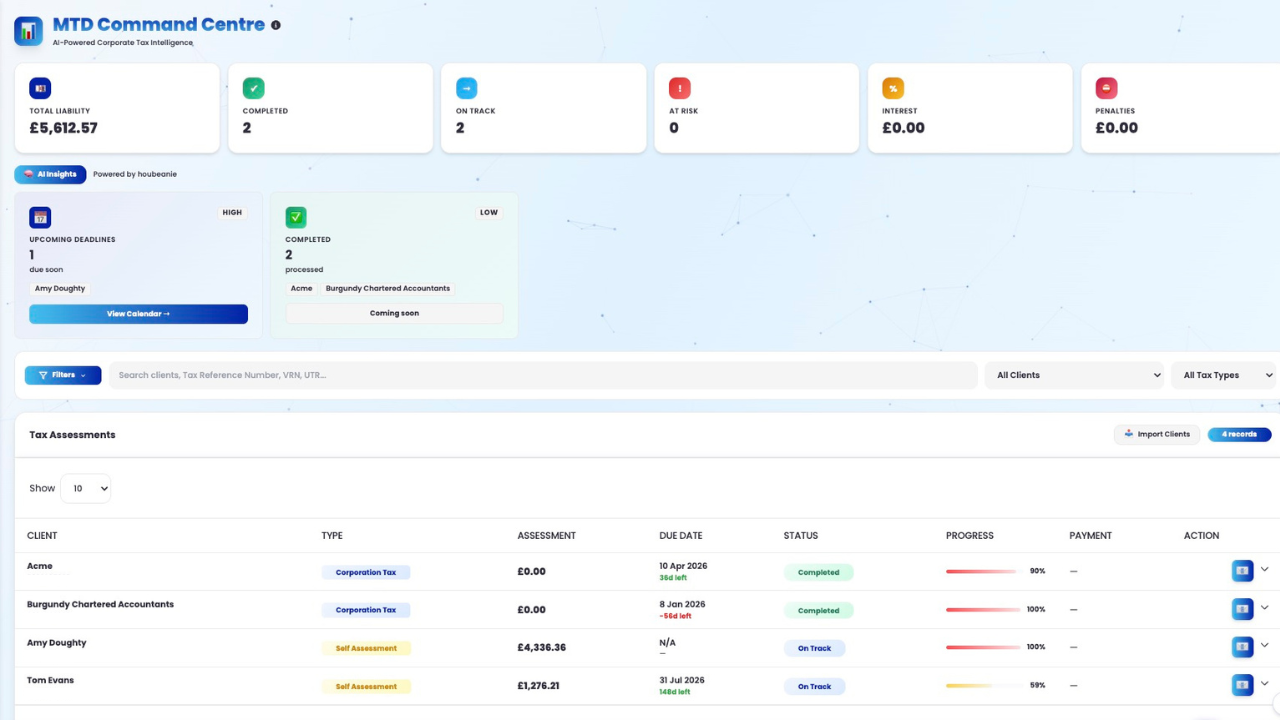
The MTD Command Centre brings together real-time tax data into a single dashboard. From one place, you can view all of your tax clients and instantly see key information such as liabilities, direct debit status, payment deadlines, and overall progress.
Having this level of visibility in one location makes it much easier to prioritise work and keep track of deadlines. Everyone knows where the information lives, and no time is wasted searching across multiple systems.
It also removes the need to constantly log into HMRC to retrieve information. Traditionally, accountants would log in repeatedly, extract data, and move it into spreadsheets or reports — only for that data to become outdated almost immediately.
With real-time insights in a single dashboard, you’re no longer working with “dead data”. Instead, you have up-to-date information available whenever you need it.
The result is a process that is faster, clearer, and far less stressful for your team.
3. Keep a client-first approach
While accountants have been hearing about MTD for a long time, many clients may still be relatively unaware of the upcoming changes.
Without an accounting background, these shifts can feel confusing or even worrying. Clients may not fully understand what’s required of them, how frequently they’ll need to provide information, or what the transition will look like.
This is why maintaining a client-first approach is so important.
Any process you design for MTD should consider the client experience from the very beginning. Communication should be simple, clear, and free from unnecessary jargon. The goal is to help clients understand what’s changing without overwhelming them.
Equally important is creating space for conversation. Clients will likely have questions, and giving them the opportunity to talk through the changes can help ease uncertainty.
By clearly explaining what MTD means for them, what actions they’ll need to take, and how your firm will support them throughout the transition, you can turn what might feel like a disruption into a positive experience.
A client-first mindset doesn’t just help with MTD compliance — it also strengthens the relationship between you and your clients.
Making MTD easier
MTD doesn’t have to feel like a looming challenge. With clear communication across your team, simple systems that reduce complexity, and a strong focus on the client experience, the transition can become far more manageable.
If you’re still unsure about how to approach MTD, or want to see how a single system could simplify the process, get in touch.
We’d be happy to show you how the MTD Command Centre can help you stay organised, reduce admin, and approach MTD with confidence.